How do I get back to sport/play? In other words ... What is the Criteria Toward Clearance?
About 70% of concussions get better within 28 days. However, no healthcare provider can predict exactly how long it will take for someone to recover. Every concussion is different, and each person heals at their own pace. A healthcare professional should not tell a family that a concussion will be gone in a certain number of days.
The best way to know if a student or athlete is ready to slowly begin returning to play/sports is to ask these important questions and make sure all the right conditions are met. Every point of Criteria Toward Clearance below must be met before a healthcare provider can "approve" the start of the Graduated Return to Play/Sports Step 4 (see PACE).
Is the student/athlete 100% "back to baseline" symptoms at home?
- Use a Symptom Checklist (there is a Symptom Checklist in the REAP APPENDIX). All symptoms should be back to the pre-concussion “baseline” symptom level (the student does not need to have "zero" symptoms; they need to be back to baseline symptoms).
- At home, your child should be acting the way they did before the concussion, doing chores, interacting normally with friends and family.
- Symptoms should not return when the child/teen is in a loud, busy environment of home/
social, mall or restaurants.
Is the student back to their pre-concussion learning level at school?
- The student should be handling school work at the same level as they did before the concussion.
- Use the Teacher Feedback Form (there is a Teacher Feedback Form in the REAP APPENDIX) to see what teachers are noticing.
- Parents/guardians should notice if student can complete homework the same as they did before the concussion.
- In-school, tests and school workload should be back to where they were before the concussion. Academic "adjustments" should be generously provided in the beginning of a concussion and weaned back as soon as they are no longer needed (no medical input needed to add in or remove academic work). However, not all make-up work needs to have been made up before clearance of the concussion.
- Symptoms should not return when the student is in the loud, busy environment of school.
Academic adjustments can be happening simultaneous to the Graduated Return to Play/Sport Steps 1, 2 and 3. However, all the academic criteria mentioned above must be met before a healthcare provider can approve the start of the Graduated Return to Play/Sport Steps 4, 5 and 6.
If the school or healthcare provider has done brain function (neurocognitive) testing, are the student’s scores back to their normal level—or at least close to what is typical for their age or what they scored before the concussion?
If an athletic trainer (AT), physical therapist (PT) or occupational therapist (OT) is involved in the concussion rehabilitation, does the AT, PT or OT feel that the student has reached his/her objective goals and been discharged from any therapies?
If the student has been visiting with the school nurse/health tech/AT weekly, are symptoms "back to [before concussion report] baseline"?
Have visits to the school clinic for symptoms of concussion stopped?
- Perform serial administrations of the Symptom Checklist
Is the student off all medications used to treat the concussion?
- This includes over-the-counter medications such as ibuprofen, naproxen and acetaminophen, which may have been used to treat headache or pain.
If the answer to any of the questions is "NO," stay the course with management and continue to repeat:
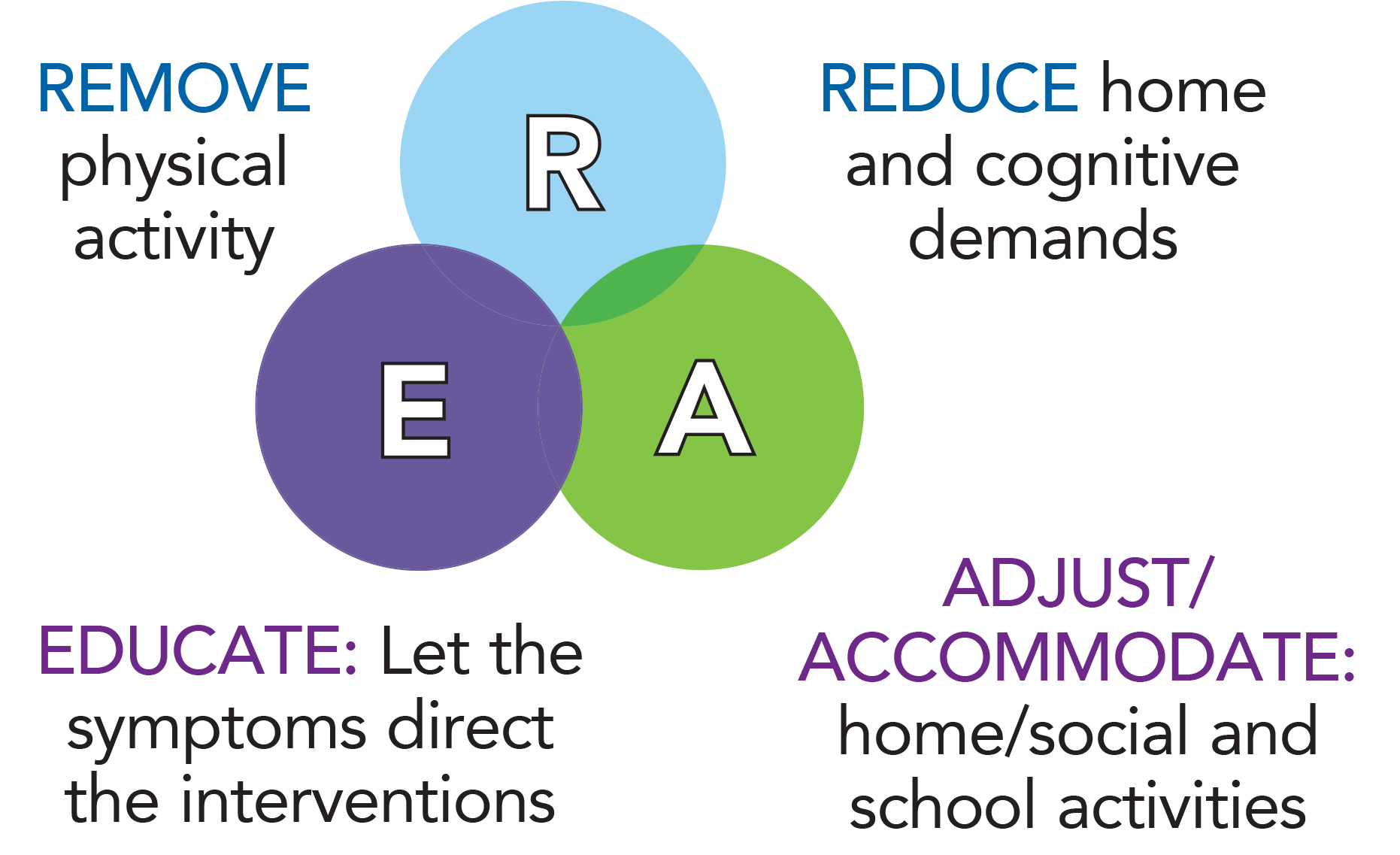
REA Framework Diagram
- R - Remove/Reduce (Blue Circle)
- REMOVE high-risk physical activity
- REDUCE home and cognitive demands
- E - Educate (Purple Circle)
- EDUCATE: Let the symptoms EDUCATE about recovery
- A - Adjust/Accommodate (Green Circle)
- ADJUST/ACCOMMODATE: home/social and school activities accordingly
The diagram shows three overlapping circles (blue, purple, and green) representing the REA framework components working together.
... for however long it takes for the brain cells to heal!
The best way to see if a student is really recovering is to notice two things:
- Their symptoms are getting better.
- They can handle more work at home, at school, and more activities with friends.
Parents and teachers: You can safely start adding back normal activities to see how the brain is doing. Let your child go to a movie or try a small quiz at school. You don’t have to wait for a “medical clearance for sports" before bringing back in home and school activities.
In fact, a student needs to get back to their normal school and home routine before they start the step-by-step plan for returning to play/sports. So go ahead and try adding back in home and school activities gradually! Just do not start adding back in high-risk physical activities yet! That needs to be done in a step-by-step manner (see PACE).
Once the answers to the questions above are all “YES,” turn the page to the PACE page to see how to start adding back in the high-risk physical steps toward play/sports!